Back to insights
Article/ Compliance
REACH in 2026: Two New SVHCs and a PFAS Foam Deadline Worth Planning For
4 min read
REACH in 2026: Two New SVHCs and a PFAS Foam Deadline Worth Planning For
Two regulatory moves in the first months of 2026 quietly changed what some buyers can ship into the EU. Neither made headlines. Both create paperwork, and one comes with a hard date.
If you source chemicals or articles for the European market, here's what actually changed — and what to do before it turns into a customs hold or a failed audit.
What changed in the Candidate List
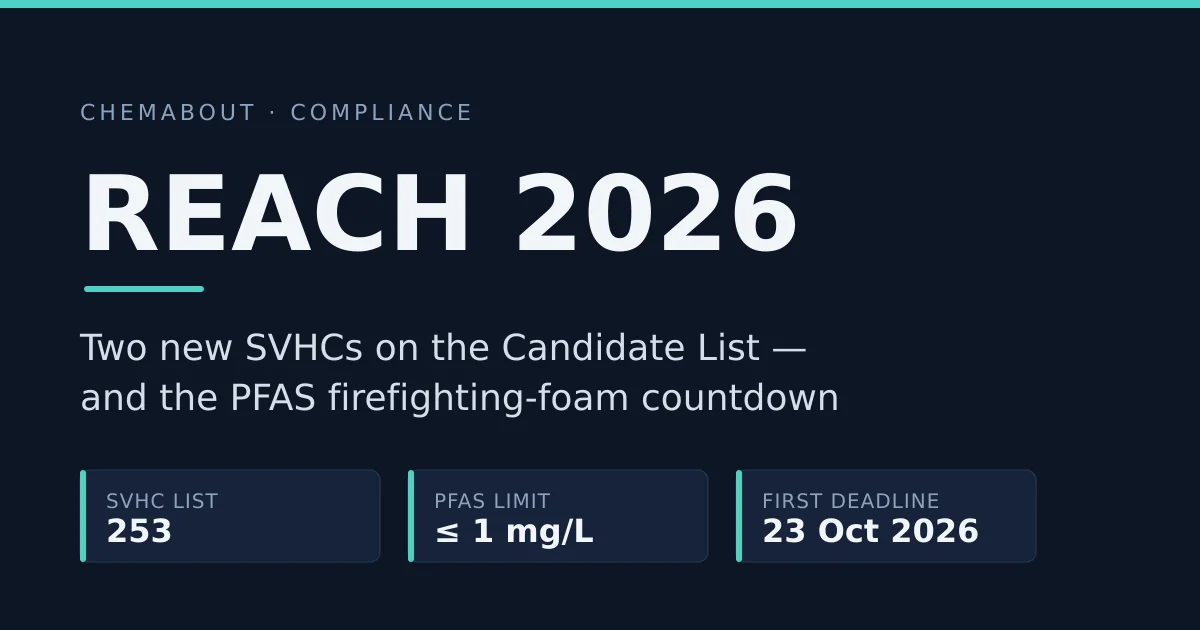
On 4 February 2026, ECHA added two substances to the REACH Candidate List of Substances of Very High Concern (SVHC), bringing the total to 253.
- n-Hexane (CAS 110-54-3). This one is unusual. It was added for neurotoxicity — specific target organ toxicity after repeated exposure — rather than the usual carcinogenic, mutagenic, or reproductive grounds. It's a common solvent in adhesives, extraction, and cleaning, so it reaches further into supply chains than its profile suggests.
- BPAF — 4,4'-[2,2,2-trifluoro-1-(trifluoromethyl)ethylidene]diphenol and its salts. Added as toxic for reproduction. Used as a monomer and intermediate in fluoropolymers and specialty plastics.
A Candidate List entry doesn't ban anything. What it does is switch on obligations:
- If an article contains either substance above 0.1% (w/w), you owe recipients enough information for safe use, and consumers an answer within 45 days of asking.
- A SCIP notification to ECHA applies for articles above that threshold.
- Producers and importers may need to notify ECHA within six months where volumes and conditions apply.
The quiet risk: n-Hexane is common enough that teams wave it through as "just a solvent." After 4 February, it's a substance your customers can formally ask you about.
The PFAS foam deadline that's already on the calendar
Separately — and this is the part people mix up — the EU has already restricted PFAS in firefighting foams. This is settled law, not a proposal. Commission Regulation (EU) 2025/1988 added entry 82 to REACH Annex XVII and entered into force in October 2025.
The definition is broad: here, PFAS means any substance with at least one fully fluorinated CF3 or CF2 carbon. The phase-out is staggered:
- 23 October 2026 — PFAS must be ≤ 1 mg/L in foams for portable fire extinguishers. From the same date, any foam still placed on the market with PFAS ≥ 1 mg/L must carry a PFAS warning label.
- 23 April 2027 — the same limit for alcohol-resistant foams in portable extinguishers, plus restrictions on training and testing use.
- 23 October 2030 — a general limit of ≤ 1 mg/L for all firefighting foams placed on the market or used.
Worth keeping separate in your head: the much broader universal PFAS restriction is still moving through ECHA's RAC and SEAC committees, with opinions expected toward the end of 2026. That one isn't law yet. The foam restriction is.
What to do before the dates land
A short, practical sequence.
1. Re-screen your catalogue against the new SVHCs
Search your product and BOM data for n-Hexane and BPAF — including as residual solvents and inside formulations, not just as headline ingredients. Above 0.1% in an article means obligations now, not later.
2. Get the question answered before a customer asks it
Ask suppliers for an updated declaration covering the 253-entry Candidate List, and the two February additions specifically. A supplier who can answer in days, with documents attached, is telling you something useful about every future request too.
3. If you touch firefighting foams, treat 23 October 2026 as a shipping cut-off
Confirm PFAS content against the 1 mg/L line, confirm the warning label, and check whether your product sits in the portable-extinguisher bucket that moves first.
4. Put the dates in your sourcing calendar
2026-10-23, 2027-04-23, 2030-10-23. Back-plan from each one for reformulation, requalification, and stock sell-through.
Common mistakes
- Treating an SVHC listing as a ban — then either over-reacting or ignoring it. It's an information obligation with a 0.1% trigger.
- Assuming everyday solvents like n-Hexane are too common to be on anyone's radar.
- Confusing the adopted firefighting-foam restriction with the still-pending universal PFAS proposal, and planning against the wrong timeline.
- Waiting for a customer or customs query to expose a gap that a one-line supplier declaration would have closed.
Final takeaway
Candidate List updates and Annex XVII deadlines rarely make the news, but they decide whether a shipment clears or sits. The February 2026 additions and the October 2026 PFAS-foam date are both manageable — if you screen now, ask suppliers in writing, and put the dates on a calendar instead of in a memo.
Related reading
- REACH adds a 2,4-DNT restriction: how one nitrotoluene residue enters the articles compliance boundary
- China’s Hazardous Chemicals Safety Law Is Now in Force: What Chemical Businesses Should Check
- Browse more compliance articles
References
- ECHA — Candidate List of substances of very high concern
- CIRS — EU REACH officially adds 2 new SVHCs (list updated to 253)
- SGS — ECHA expands Candidate List to 253 SVHCs
- UL Solutions — New EU restriction on PFAS in firefighting foams
- IHK Braunschweig — PFAS-Beschränkung für Feuerlöschschäume tritt in Kraft