Back to insights






Category
Compliance
Compliance, regulations, and market access topics.
Article20 min read
A Safety Data Sheet Is Not a Market Passport: What It Can—and Cannot—Establish in Chemical Trade
A safety data sheet is the principal legally prescribed document for passing a chemical's hazards and safe-handling information to the next holder. Under EU and GB REACH, the US Hazard Communication Standard and China's Hazardous Chemicals Safety Law, it carries fields that bear on registration, batch quality, transport and market access, but on its own it settles none of them.
Article19 min read
India's Paraquat Decision: The Law, the Chemistry and the Alternatives
India's order of 22 September 2026 prohibits the registration of paraquat dichloride and cancels its certificates from Gazette publication. What the order says compared with the July draft, what paraquat did on Indian farms, the chemistry behind its use and hazards, and the limits of the evidence on alternatives in tea.
Article23 min read
PFAS Regulation Enters a New Phase: What 2026 Changes for the Chemical Industry
The 10 October 2026 PFHxA deadline marks a wider shift in EU PFAS regulation, from individual substances toward class-level management. No universal restriction has been adopted yet. For industry, the substitution challenge is reproducing a performance envelope, not finding one replacement molecule.
ArticleChemAbout Editorial Team9 min read
Why Does Dimethyl Disulfide (DMDS) Show Up in Refinery, Farm, and Food-Flavor Supply Chains?
DMDS (CAS 624-92-0) is a refinery catalyst presulfiding agent, an EPA-registered soil fumigant, and a FEMA GRAS flavor compound — three separate regulatory regimes under one CAS number. Here's what buyers need to confirm before sourcing it.
ArticleChemAbout Editorial Team9 min read
1,3-Propane Sultone as a Li-ion Electrolyte Additive: How It Builds the SEI, What Battery Grade Really Means, and the Regulatory Record
1,3-Propane sultone (PS, CAS 1120-71-4) appears in almost every high-voltage or high-temperature Li-ion electrolyte recipe. Grounded in first-principles studies and the current ECHA/CLP record, this article covers how PS builds the SEI before the solvent breaks down, the trace parameters that define battery grade, and the regulatory status of a Category 1B carcinogen on the REACH Candidate List.
ArticleChemAbout Editorial Team4 min read
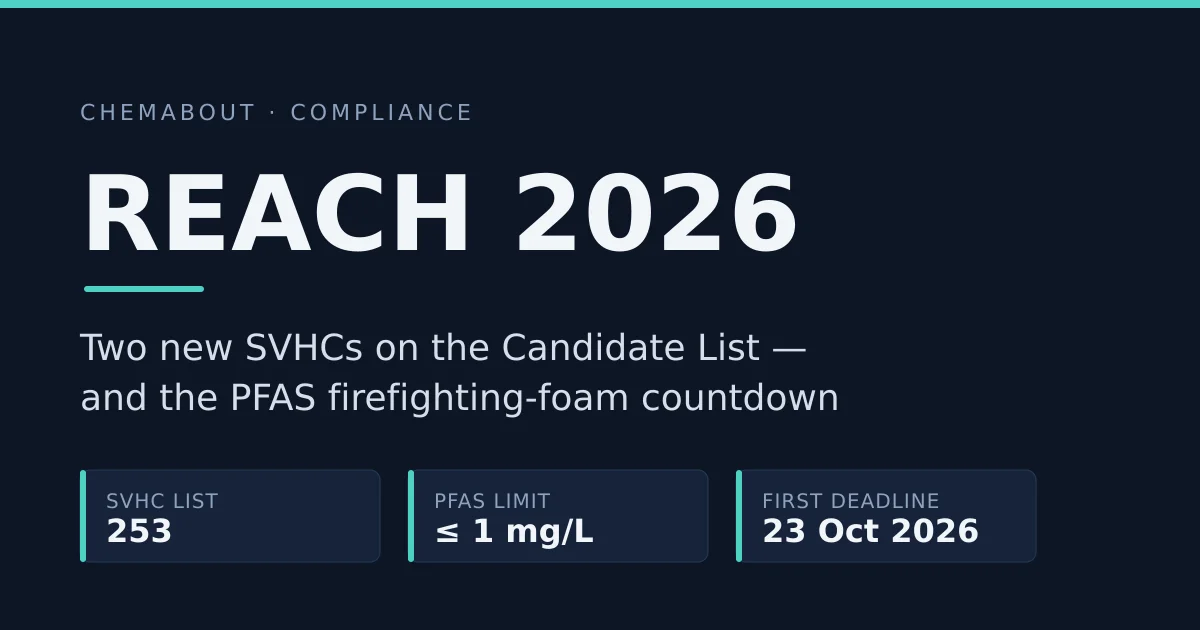
REACH in 2026: Two New SVHCs and a PFAS Foam Deadline Worth Planning For
ECHA added n-Hexane and BPAF to the REACH Candidate List in February 2026, and the EU's PFAS firefighting-foam restriction hits its first hard deadline in October. Here's what to screen, what to ask suppliers, and which dates to put on your sourcing calendar.
Article4 min read
REACH adds a 2,4-DNT restriction: how one nitrotoluene residue enters the articles compliance boundary
Commission Regulation (EU) 2026/859 adds 2,4-DNT to REACH Annex XVII. The change is narrow but precise: it turns a hazardous substance classification into article-level limits, dates, thresholds and exemptions.
GuideChemAbout Editorial Team8 min read
China’s Hazardous Chemicals Safety Law Is Now in Force: What Chemical Businesses Should Check
China’s Hazardous Chemicals Safety Law has been in force since May 1, 2026. Chemical manufacturers, importers, sellers, buyers, operators, and exporters should review licenses, SDS, labels, registration, and transaction controls.