Back to insights
Article/ Industry Insights
Why One Cracker Closure Can Take Down a Whole Chemical Site
19 min read
ChemAbout Insight · Steam crackers and integrated chemical sites in Europe
Status as of 23 October 2026. Closure dates are as announced by the companies named; announced closures can be revised. "Whole site" means how far a closure's effects reach across a connected site, not that every plant on it shuts.
◆ KNOWLEDGE CARD — 5-minute overview
Before You Read
This article is for you if you are:
- Working in strategy, site operations or supply chain at a European chemical producer
- Buying olefins, polymers, chlor-alkali products or their derivatives from European sites
- Following why closures in European basic chemicals keep arriving in clusters
By the end, you will understand:
- What a steam cracker supplies to the plants around it besides ethylene
- Why chlorine chemistry is tied to the place where it is made
- Why a closure can travel downstream, upstream and sideways through a site
- Why a regional surplus of ethylene does not protect the plant next door
One-Sentence Answer
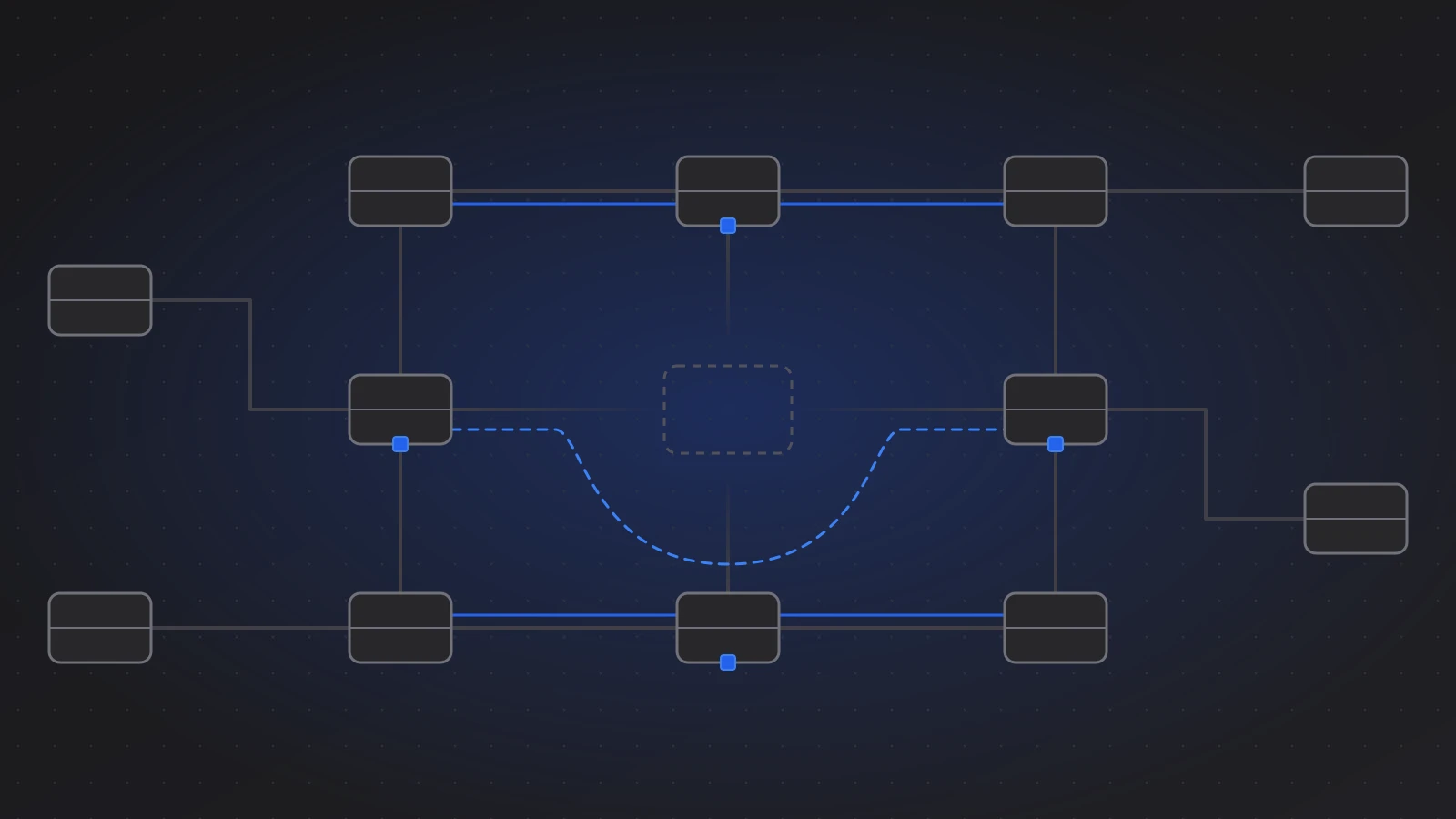
A steam cracker on an integrated site is not just a seller of ethylene into a market; it is a node that sends several molecules down pipelines to its neighbours and depends on their demand in return, so when one node closes, the plants linked to it lose a site-gate supply or an outlet that a shipped replacement does not match on cost, specification or quantity.
Cefic and Roland Berger count roughly 37 million tonnes of chemical capacity announced for closure in Europe between 2022 and 2025—close to 9% of total capacity, with upstream petrochemicals accounting for nearly half.
Knowledge Graph — the map first
                          ┌──→ Ethylene ──→ polyethylene, EDC/VCM ──→ PVC
Naphtha ──→ Steam cracker ┼──→ Propylene ──→ polypropylene (at Böhlen, a neighbour's plant)
   (main line)            └──→ C4 stream ──→ butadiene extraction
        │
        ├──→ Coupling branch: brine ──→ chlor-alkali ──→ chlorine (used on or next to site)
        │                                     └──→ + ethylene ──→ EDC ──→ VCM ──→ PVC
        │
        └──→ Exposure branch: who buys what the cracker makes
                 ├──→ captive units on the same site  ··· survive with the cracker
                 └──→ third-party offtakers           ··· can end the cracker, or end with it
Three paths lead from this map: the main line (what a cracker produces and where it goes), the coupling branch (how chlorine and ethylene meet in the vinyl chain) and the exposure branch (which side of each pipeline carries the risk). The Deep Dive walks all three.
Mental Model
Regional market:   Europe ──── more ethylene than it needs ────→ "no shortage"
                                     ≠
Site economics:    Plant A ══pipeline══ Plant B
                   (closes)             (loses a site-gate feed or an outlet;
                                         the replacement arrives by ship, at a cost)
A regional surplus describes how many tonnes exist; a site's survival depends on how those tonnes arrive.
◆ INSIGHT ARTICLE — 20–30 minute deep read
Deep Dive
Each section leads with the answer, then the reasons; the sections can be read in any order.
What does a cracker supply to the site around it?
Fundamental ★★★★★ Must-read
Answer: several products, not one—and each of them can have a different downstream user.
- One feed, several products. A naphtha cracker turns a single hydrocarbon feed into ethylene alongside other products, including propylene and a C4 stream from which butadiene is extracted. ChemAbout's earlier piece on crude-oil benchmarks covers why naphtha-based ethylene is costlier than ethane-based ethylene; this article is about what happens around the cracker once it exists.
- A real slate. Dow's naphtha cracker at Böhlen in eastern Germany has a nameplate capacity of 540,000 t/yr of ethylene and 285,000 t/yr of propylene, and a butadiene extraction unit of 105,000 t/yr, according to Argus (July 2025). Böhlen's nameplate capacities are roughly two tonnes of ethylene for every tonne of propylene; this is a capacity comparison, not an operating-output ratio. (ChemAbout analysis.)
- The products leave by different routes. Propylene from Böhlen goes to a polypropylene plant at nearby Schkopau that Dow sold to Braskem in 2011 (Argus, July 2025). Three companies at the Leuna site depend on ethylene from Böhlen, and alternative supply routes would cause considerable extra costs, according to regional reporting (Leuna Echo, 7 July 2025).
A cracker's customers are not interchangeable: closing it removes the same local source from its propylene and its ethylene customers, unless alternative routes are established first.
Engineering Insight: A cracker built to make ethylene also makes propylene and C4s, and each of those products needs a buyer. At Böhlen, one of those buyers is a neighbouring plant owned by another company. (ChemAbout analysis.)
Why is chlorine chemistry tied to the place where it is made?
Fundamental ★★★★★ Must-read
Answer: because chlorine is difficult to store and transport economically, so it is consumed where it is produced—and the largest consumer, the vinyl chain, also needs ethylene.
- Chlorine barely travels. The EU's reference document for the chlor-alkali sector states: "Chlorine is difficult to store and transport economically and, therefore, chlorine is generally produced near consumers"; when it is moved, it goes by pipe "typically over distances ≤ 10 km", road or rail (JRC, Chlor-alkali BREF, 2014). In 2012 about 570 kt of chlorine went by rail and road in the EU-27 and EFTA countries, which means "approximately 94 % were used on the same or adjacent sites" (same source, citing Euro Chlor).
- The vinyl chain is the biggest user. PVC took 3,245 kt, or 33.3%, of chlorine consumption in the EU-27 and EFTA countries in 2012 (same source). PVC is made from vinyl chloride monomer (VCM), which is made from ethylene dichloride (EDC), which combines ethylene with chlorine.
- The traded form is the derivative. Chlorine itself is "transported and traded over long distances as chlorinated derivatives, particularly as EDC, VCM and PVC" (same source). What usually travels long distances is what is made after chlorine has met ethylene.
- Caustic soda comes with it. Brine electrolysis produces sodium hydroxide in proportion to chlorine—in practice 1.070 to 1.128 tonnes per tonne of chlorine—so a chlor-alkali unit cannot make one without the other (same source, section 1.4.2).
Chlorine is the clearest case of a molecule that belongs to a site rather than to a market. (ChemAbout analysis.)
Market Insight: When European chlorine capacity closes, replacement is more likely to arrive as EDC, VCM or PVC than as chlorine itself—a different product sold to a different customer. (ChemAbout analysis.)
What happened when Böhlen and Schkopau were scheduled to close together?
Industry ★★★★☆ Case study
Answer: Dow scheduled the cracker and the chlor-alkali and vinyl assets next to it for the same quarter, and kept running the Schkopau polyethylene units, which have another ethylene supply.
- The announcement. On 7 July 2025 Dow said it would shut the Böhlen ethylene cracker and the Schkopau chlor-alkali and vinyl (CAV) assets, both in the fourth quarter of 2027; Dow said implementation across its wider three-asset programme would begin in mid-2026. About 800 roles are affected. Dow said the closures would "right-size regional capacity, reduce merchant sale exposure" and remove "higher-cost, energy-intensive portions" of its portfolio (Dow, 7 July 2025).
- What sits at Schkopau. Schkopau has 250,000 t/yr of membrane-cell chlor-alkali capacity and 740,000 t/yr of EDC capacity. Dow had already closed the larger of its two VCM lines in 2024, cutting VCM capacity from about 330,000 t/yr to about 110,000 t/yr (Argus, July 2025).
- What survives. Dow's polyethylene units at Schkopau—210,000 t/yr of LLD-HDPE and 108,000 t/yr of LDPE—were not part of the review and continue to operate. An ethylene pipeline links them to Dow's storage and import infrastructure at Stade (Argus, July 2025).
- Who else is affected. Braskem's Schkopau polypropylene plant receives propylene from Böhlen (Argus, July 2025). InfraLeuna's managing director, Christof Günther, said the closure "schwächt den mitteldeutschen Stoffverbund erheblich" ("considerably weakens the Central German materials network"), and the regional chemical association VCI Nordost warned that if the cracker goes, whole supply chains begin to falter (Leuna Echo, 7 July 2025, citing the Mitteldeutsche Zeitung).
Dow did not describe the CAV closure as caused by the cracker closure. (ChemAbout analysis:) the two assets sit on the same molecule chain—ethylene and chlorine meet in EDC—and they were scheduled for the same quarter.
In the Schkopau example, the units that stay open are the ones with a second pipe. (ChemAbout analysis.)
Market Insight: The phrase "reduce merchant sale exposure" describes the closure from the cracker owner's side. From the other side of the fence, the same tonnes were a neighbour's feedstock.
What happens to a plant whose feedstock came over the fence?
Industry ★★★★★ Must-read
Answer: it keeps running only by shipping in the same molecule from further away—and at Brindisi, that has not been enough.
- The dependency. LyondellBasell's polypropylene plant at Brindisi in southern Italy, with a nameplate capacity of 260,000 t/yr, took up to 220,000 t/yr of propylene from Eni's Versalis cracker on the same site (Argus, 11 June 2026).
- The upstream closure. The Versalis cracker closed in April 2025 (Argus, 11 June 2026).
- The replacement. LyondellBasell has no propylene production of its own at Brindisi; feedstock now arrives by sea, mainly from Priolo in Sicily, adding "significant freight costs" (Argus, 11 June 2026).
- The outcome. In June 2026 LyondellBasell said it intended to close the unit by the end of the year, citing "challenging macroeconomic environment, persistent uncertainty around feedstock availability," and structurally higher operating and logistics costs. According to union sources, the closure is contingent on no acceptable alternative being found. The unit has been offered for sale; a union representative said a buyer would be hard to find without the cracker, and that Eni had hired JPMorgan to look for a buyer for the cracker itself (Argus, 11 June 2026).
LyondellBasell named several causes, not only the loss of the cracker. The sequence is still clear: the propylene that once came by pipe now comes by ship.
Propylene did not become scarce in Europe; it became expensive at Brindisi.
Procurement Insight: "Feedstock security" for a downstream polymer plant is often a statement about a single neighbour. Where a downstream producer has no upstream production of its own, the relevant question is what the alternative supply route costs, not whether the molecule exists elsewhere in the region.
Can the dependency run the other way?
Industry ★★★★☆ Case study
Answer: yes—a cracker that sells into a third party's plant depends on that buyer as much as the buyer depends on it.
- Two crackers, one site. TotalEnergies operates two steam crackers at Antwerp. On 22 April 2025 it announced that it intends to stop operating the older one by the end of 2027 (TotalEnergies, 22 April 2025).
- The reason given. The company cited "the significant surplus of ethylene expected in Europe" and the decision by a major third-party buyer of the older cracker's ethylene not to renew its contract. That cracker is not linked to TotalEnergies' own polymer production, so it would have had no outlet for its ethylene (TotalEnergies, 22 April 2025).
- The one that stays. The newer cracker continues, and its ethylene "is entirely consumed by TotalEnergies' industrial units in Antwerp and Feluy" (TotalEnergies, 22 April 2025). TotalEnergies says the 253 employees concerned are being offered retirement or an internal move, without layoffs.
On the same site, the cracker with a captive outlet stays and the one that relied on a single outside buyer closes.
Market Insight: Offtake contracts on integrated sites work in both directions. Their renewal dates mark points at which the supplier, the buyer or both can leave. (ChemAbout analysis.)
Is this only a cracker problem?
Advanced ★★★☆☆ Comparative case
Answer: no—a similar mechanism appears wherever a plant depends on a long-standing supplier of a raw material it cannot readily replace. (ChemAbout analysis.)
- The supplier. Vencorex, a French chemical producer, was the historical salt supplier to Arkema's Jarrie site in the Isère, under a contract in place since 1968 and in force until 2027. Vencorex went into receivership on 10 September 2024 (Arkema, 21 January 2025).
- The dependency. Arkema says the salt supply stopped abruptly on 23 October 2024, and that Vencorex's parent company, PTT GC, declined in a letter of 29 November 2024 to support a salt solution (Arkema, 21 January 2025).
- Why substitution was not enough. Arkema found replacement salt, but said it was not compatible "in terms of specifications, cost and quantity" with keeping every activity at Jarrie running. It proposed to keep hydrogen peroxide, chlorate and perchlorate production and to shut chlorine, caustic soda, methyl chloride and technical fluids, cutting 154 of 344 positions (Arkema, 21 January 2025).
Arkema's three words—specifications, cost and quantity—describe what a historically qualified supply provided and the substitute did not. (ChemAbout analysis.)
Engineering Insight: The Jarrie case involves no cracker and no ethylene. What links it to Böhlen and Brindisi is dependence on a historically qualified supplier that was not readily replaceable. (ChemAbout analysis.)
Why does a regional surplus not rescue the plant next door?
Advanced ★★★★☆ Synthesis
Answer: because a surplus is measured in tonnes across a region, while a site competes on the delivered cost, specification and reliability of each input.
- The surplus is real. TotalEnergies justified its Antwerp closure partly by "the significant surplus of ethylene expected in Europe," and Dow framed its closures as a way to "right-size regional capacity" (company statements, 2025). Neither company describes a shortage.
- The neighbours' problem is still real. LyondellBasell's replacement propylene arrives by ship with "significant freight costs"; Arkema's replacement salt did not meet "specifications, cost and quantity"; Leuna's ethylene users would face considerably higher costs on alternative routes, according to regional reporting (sources as above).
- Decoupling needs infrastructure. Dow's Schkopau polyethylene units can continue because a pipeline connects them to storage and imports at Stade (Argus, July 2025). Where such a link exists, a closure upstream can be absorbed; where it does not, the replacement arrives by sea, rail or road. (ChemAbout analysis.)
Closure risk follows the pipeline map, not the regional balance sheet. (ChemAbout analysis.)
Procurement Insight: A European supplier's continuity depends on more than its own plant. The upstream units and the offtakers it is connected to by pipe can matter as much as its own cost position. (ChemAbout analysis.)
Industry Insight
Taken together, the cases describe one mechanism seen from different sides. On an integrated European site, a steam cracker or a chlor-alkali unit is a node that sends several products down short pipelines to identified neighbours and depends on their demand in return. Chlorine is the extreme case: in 2012 about 94% of chlorine in the EU-27 and EFTA countries was used on the site where it was made or an adjacent one.
When one node closes, the effect is not a regional shortage. Neither TotalEnergies nor Dow describes a shortage. The effect is a change in cost position for each plant connected to the closed node. A downstream plant loses a site-gate feed and has to replace it by ship, as LyondellBasell does at Brindisi. Or a plant loses a historically qualified raw material that a substitute does not match, as Arkema did at Jarrie. In the reverse direction, a cracker that sold to a single outside buyer loses its outlet, as at TotalEnergies' older Antwerp unit. The two surviving olefins-linked units highlighted here have a captive outlet or a second pipe: TotalEnergies' newer Antwerp cracker, and Dow's Schkopau polyethylene units. (ChemAbout analysis.)
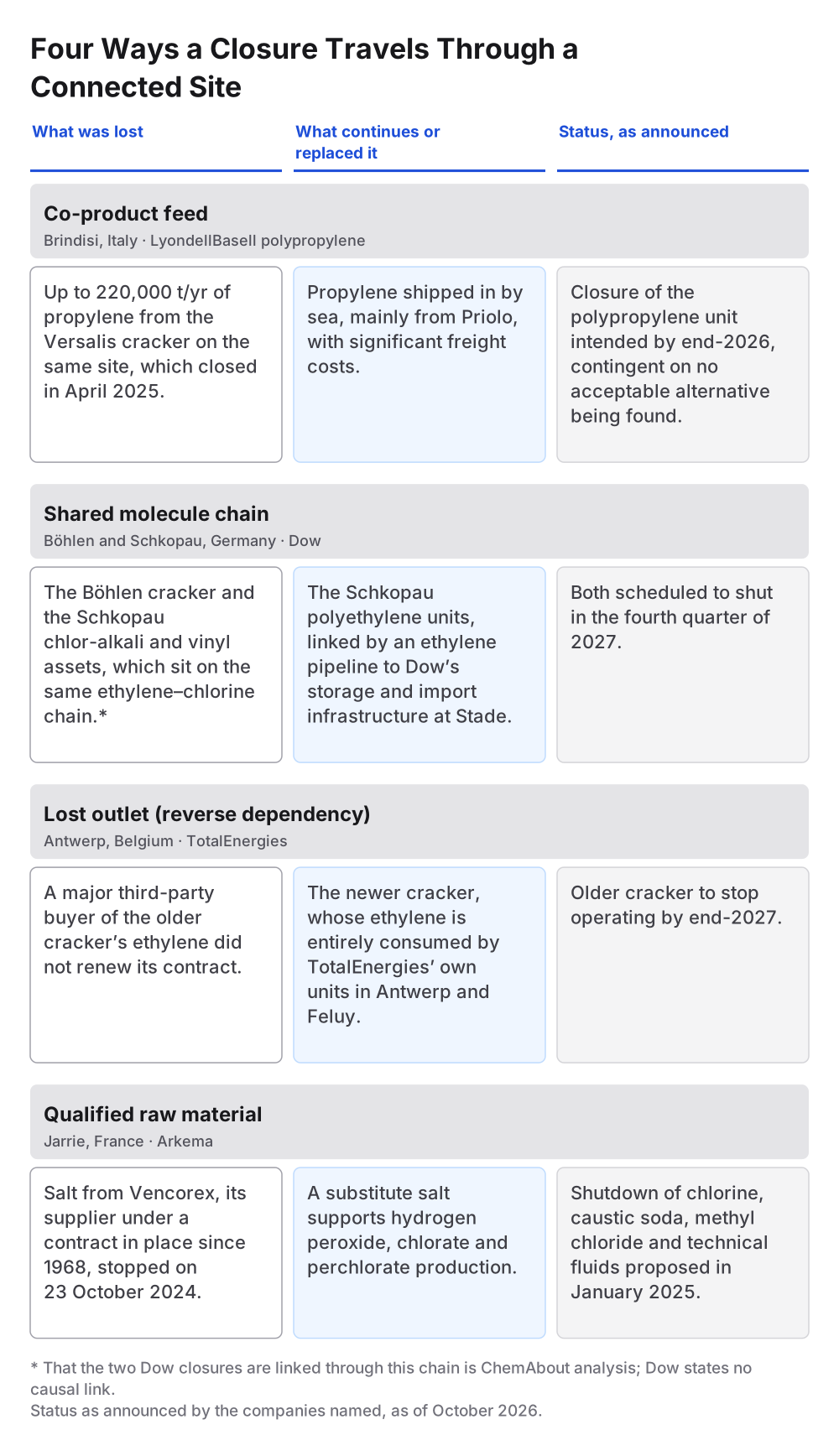
In European basic chemicals, the unit that competes is the connected site, not the individual plant. (ChemAbout analysis.) Roland Berger, in its 2026 closures study for Cefic, notes the "integrated chemical clusters across Europe, which might be leading to a cascading and accelerating effect."
That raises the next question: will the cascade stop? The cases suggest it depends on whether each remaining node keeps a captive outlet or an alternative connection, rather than on any single plant's own margin. (ChemAbout analysis.) The Böhlen and Schkopau shutdowns are scheduled for the fourth quarter of 2027. Brindisi's polypropylene unit is due to close by the end of 2026 unless an acceptable alternative is found. Both mark points at which the connected plants around them either find another link or face a weaker cost position. (ChemAbout analysis.)
What Surprised Us
Most people think: a closure is a problem only when Europe is short of the product. Reality: the companies closing crackers cite an expected ethylene surplus, and their neighbours still face higher costs or closure, because the replacement has to be shipped in.
Most people think: chlorine is a commodity like caustic soda. Reality: in 2012 about 94% of chlorine in the EU-27 and EFTA countries was used on the same or an adjacent site; what usually travels long distances is EDC, VCM or PVC rather than chlorine itself.
Most people think: the downstream plant is always the dependent one. Reality: TotalEnergies is closing an Antwerp cracker after a major outside buyer chose not to renew, and kept the cracker whose ethylene its own units consume.
Continue Exploring
Follow the feedstock branch: How crude-oil benchmarks set petrochemical intermediate prices
Follow the value branch: Why the chemical industry doesn't sell molecules
Future topics on this map: the European vinyl chain after the chlor-alkali exits; ethane import infrastructure and Europe's new crackers; what a chemical-park operator owns and what it does not.
Evidence Notes
Evidence grading (applied consistently across the ChemAbout article series) [A] Academic Literature — peer-reviewed academic journals. [B] Official Documents — official or legally authoritative records (legislation, regulatory publications, official standards and guidelines). [C] Industry Sources — trade-association reports, company disclosures, or market research. [D] ChemAbout Inference — reasoning specific to this article, built on [A]/[B]/[C] evidence above, not an independently verified result.
Key Facts
- Chlorine "is difficult to store and transport economically and, therefore, chlorine is generally produced near consumers"; when transported, by pipe "typically over distances ≤ 10 km", road and rail (JRC, Best Available Techniques Reference Document for the Production of Chlor-alkali, 2014, section 1.4.1) [B].
- In 2012, about 570 kt of chlorine was transported by rail and road in the EU-27 and EFTA countries, so "approximately 94 %" was used on the same or adjacent sites; PVC accounted for 3,245 kt (33.3%) of 9,747 kt chlorine consumption (same source, citing Euro Chlor) [B].
- Chlorine is traded over long distances as derivatives, "particularly as EDC, VCM and PVC" (same source, section 1.4.3) [B].
Industrial Map
- Dow Böhlen cracker: 540,000 t/yr ethylene, 285,000 t/yr propylene, 105,000 t/yr butadiene extraction (nameplate; Argus, 7 July 2025) [C].
- Dow Schkopau: 250,000 t/yr chlor-alkali, 740,000 t/yr EDC, VCM about 110,000 t/yr after a 2024 line closure; PE units of 210,000 t/yr (LLD-HDPE) and 108,000 t/yr (LDPE) continue, with a pipeline to Stade (Argus, 7 July 2025) [C].
- Braskem's Schkopau PP plant receives propylene from Böhlen (Argus, 7 July 2025) [C].
- That the Böhlen cracker and the Schkopau CAV assets are linked through the ethylene–chlorine chain is this article's reading; Dow did not state a causal link [D].
Regulatory Status
- Not applicable. The closures discussed are company decisions; no regulatory decision is described.
Supply Chain Notes
- Cefic, 28 January 2026: about 37 Mt of announced closures 2022–2025, around 9% of European capacity, a sixfold rise; 20,000 direct jobs lost and an estimated 89,000 indirect jobs at risk [C].
- Roland Berger, 18 March 2026: upstream petrochemicals account for "nearly 50%" of announced closures; Germany and the Netherlands for nearly half [C].
- Dow, 7 July 2025: Böhlen and Schkopau CAV shutdown expected 4Q 2027; about 800 roles [C].
- TotalEnergies, 22 April 2025: older Antwerp cracker to stop by end-2027; third-party offtake not renewed; newer cracker's ethylene fully consumed by its Antwerp and Feluy units [C].
- Argus, 11 June 2026: LyondellBasell Brindisi PP (260,000 t/yr) took up to 220,000 t/yr propylene from the Versalis cracker, which closed in April 2025; closure intended by end-2026 [C].
- Arkema, 21 January 2025: salt procurement contract with Vencorex in place since 1968 and in force until 2027; supply to Jarrie stopped from 23 October 2024; proposed shutdowns affecting 154 of 344 positions [C].
- Leuna Echo, 7 July 2025, citing the Mitteldeutsche Zeitung: three Leuna companies depend on Böhlen ethylene (reported speech); quote from InfraLeuna's managing director. Regional press, not company disclosure [C].
- That a site's exposure follows its pipeline connections rather than the regional supply balance is this article's synthesis [D].
Sources & Method
- Company statements by Dow, TotalEnergies and Arkema (the latter in its AMF-filed English release), and the Cefic and Roland Berger releases, were read directly. The JRC chlor-alkali reference document was read in full text for chapter 1.
- Capacity figures for Böhlen, Schkopau and Brindisi come from Argus trade reporting; capacity figures are nameplate and differ between outlets.
- Written in October 2026; closure schedules change, and the dates above record the announcements cited.
Source References
Official documents
Associations and studies
- Cefic — Chemical plant closures surge six-fold in Europe since 2022, reaching 37Mt (28 January 2026)
- Roland Berger — Europe's chemical industry: structural reset (18 March 2026)
Companies
- Dow — Dow will shut down three upstream European assets in response to structural challenges in the region (7 July 2025)
- TotalEnergies — Antwerp Platform Adapts to Energy Transition Challenges and Market Trends (22 April 2025)
- Arkema — Arkema announces a project to refocus the activity of its Jarrie site in order to ensure its future following the cessation of its salt supply by Vencorex (21 January 2025; AMF-filed English release, PDF)
Market and trade reporting