Insights
Analysis that starts from specific chemicals and raw materials — grounded in published literature, company announcements, regulatory documents, and industry data — unpacking the science, manufacturing, and compliance behind them, alongside chemical regulations, materials technology, company moves, and supply-chain risks. Fact-based industry observation and judgment.
Continue through the broader archive covering procurement, compliance, supplier evaluation, and product workflow topics.
Page 3
DMDS (CAS 624-92-0) is a refinery catalyst presulfiding agent, an EPA-registered soil fumigant, and a FEMA GRAS flavor compound — three separate regulatory regimes under one CAS number. Here's what buyers need to confirm before sourcing it.
Nearly every supplier that sells β-NAD⁺ also offers D-ribose. This article explains why - from the shared PRPP/ribose biochemistry to a common fermentation-and-purification manufacturing platform, the grade-and-regulatory logic of sourcing, and why β-NAD⁺ is a high-value, degradation-prone material. What connects the two is a supply chain, not a function. States only verifiable facts; no health claims.
HATU, HBTU and T3P dominate peptide and pharma amide-bond formation, but they differ in reactivity, epimerization, workup and — critically — regulatory status. Grounded in the El-Faham & Albericio review and the ACS GCIPR safety assessment, this article sets out how the three reagents actually differ, why HATU couples cleaner than HBTU, and why T3P is a CWC Schedule 2 controlled chemical while HATU and HBTU are not.
1,3-Propane sultone (PS, CAS 1120-71-4) appears in almost every high-voltage or high-temperature Li-ion electrolyte recipe. Grounded in first-principles studies and the current ECHA/CLP record, this article covers how PS builds the SEI before the solvent breaks down, the trace parameters that define battery grade, and the regulatory status of a Category 1B carcinogen on the REACH Candidate List.

Between 2024 and 2026, some material directions advanced roughly on schedule — silicon carbide, carbon fiber — while others, like PFAS alternatives, green methanol and AI-designed catalysts, show a real gap between what's been announced and what's actually deployed. This piece separates genuine, dated progress from hype and unproven claims across five materials directions, drawing on English, Japanese and German primary sources.

On 17 June 2026, the U.S. Department of Commerce and SandboxAQ signed a definitive $500 million CHIPS Act R&D award to use physics-based AI for discovering new semiconductor-manufacturing chemistries, including PFAS-free alternatives.

2026 has been a concentrated year for peptide therapeutics. Efficacy reached a new high in late-stage trials, the obesity field moved beyond the incretins to amylin, the oral route reached weight management, and peptide-guided radioligand therapy kept advancing — each point tied to a specific 2025–2026 result.

"Electronic resin" is not one material. It is a family of electronic-grade polymers — epoxy molding compounds, laminate resins, build-up films, and photoresists — defined less by what they are made of than by the electrical, thermal, and dimensional numbers they must hit.

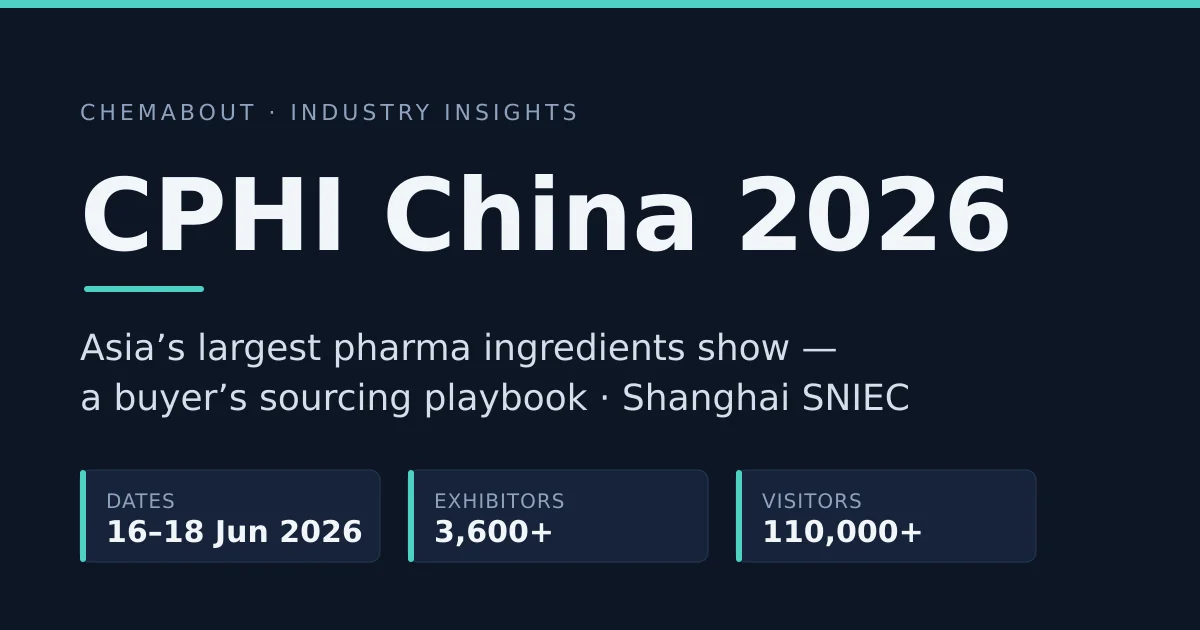
CPHI & PMEC China — 3,600+ exhibitors, 110,000+ visitors — opens 16 June at Shanghai's SNIEC. A practical playbook for buyers: go in with a shortlist, qualify suppliers on the floor, and fix the follow-up before you fly home.

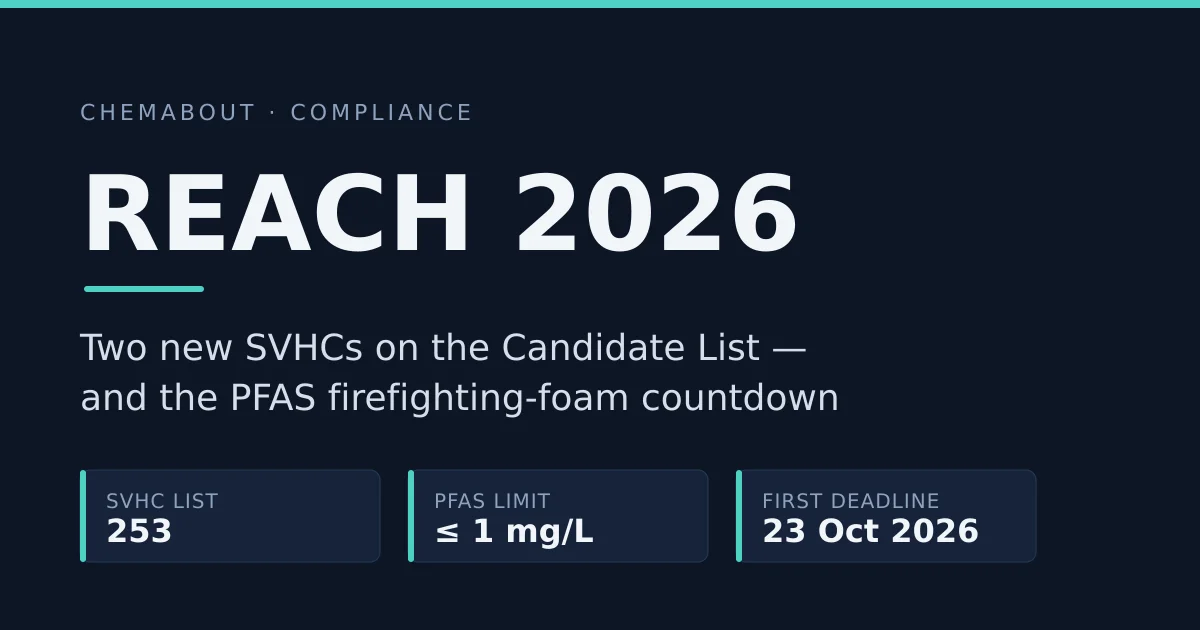
ECHA added n-Hexane and BPAF to the REACH Candidate List in February 2026, and the EU's PFAS firefighting-foam restriction hits its first hard deadline in October. Here's what to screen, what to ask suppliers, and which dates to put on your sourcing calendar.

Container spot rates rose sharply in early June 2026 as front-loading, Red Sea diversions, low idle capacity and carrier surcharges compressed available space.

SINOSURE is China's policy-oriented export credit insurer, linking export contracts, buyer credit, country risk, claims and trade finance.