Back to insights
Article/ Industry Insights
Asia's Biggest Pharma Show Is Back: A Sourcing Playbook for CPHI & PMEC China 2026
4 min read
Asia's Biggest Pharma Show Is Back: A Sourcing Playbook for CPHI & PMEC China 2026
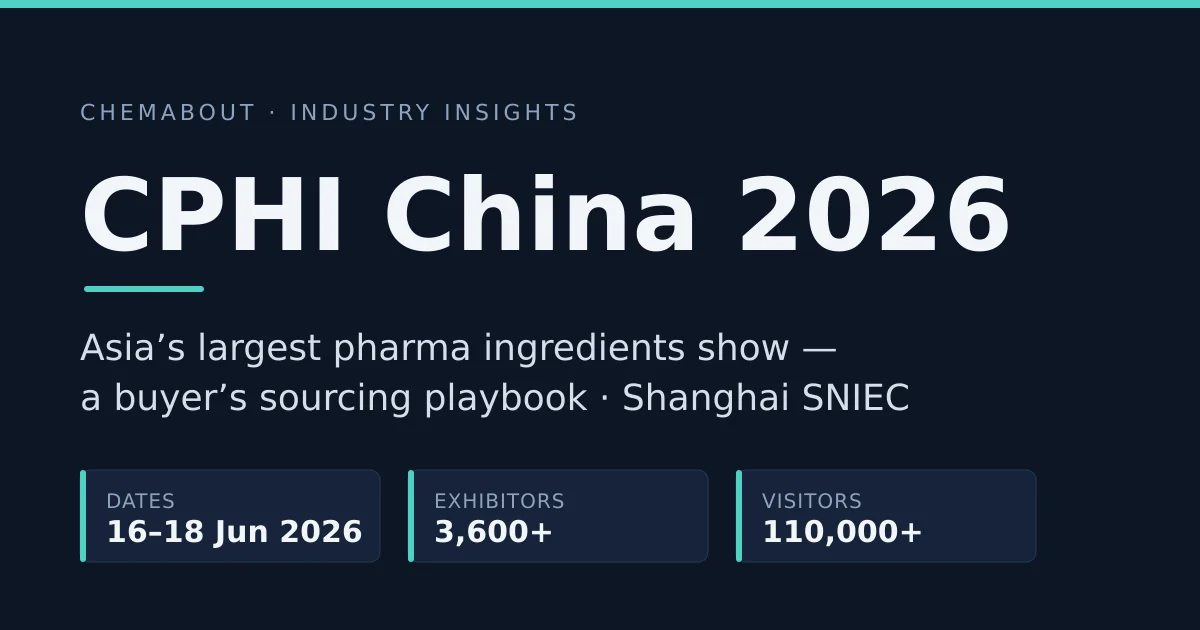
Tomorrow, 16 June, the 24th CPHI & PMEC China opens at the Shanghai New International Expo Centre (SNIEC) in Pudong. For three days it is the densest concentration of pharmaceutical ingredient supply anywhere: more than 3,600 exhibitors across roughly 240,000 square metres, with over 110,000 visitors expected from 150-plus countries and regions.
If you source APIs, intermediates, or excipients, that scale is both the opportunity and the trap. You can meet a year's worth of potential suppliers in three days — or lose three days collecting brochures you'll never act on. Here's how to make it the former.
Why a show like this still matters
Most pharma sourcing now starts online, so it's fair to ask why a physical floor still earns the airfare. Three reasons hold up:
- You meet manufacturers directly, not just the traders sitting between you and the plant.
- You read signals you can't read in a PDF — how a team answers a hard technical question, whether they can talk GMP and audits fluently, and (through PMEC's co-located machinery and packaging halls) what their process actually looks like.
- You compare many suppliers in a compressed window, which is hard to replicate over email across time zones.
The density cuts both ways, though. Without a plan, 3,600 booths is noise.
What's new in 2026
This is the 24th edition of CPHI China, co-located with the 19th PMEC China (machinery, packaging, and materials), so the floor spans the chain from molecule to finished line.
- Expanded Traditional Chinese Medicine (TCM) pavilions and a next-generation API showcase — a deliberate nod to China's two strengths: heritage extracts and advanced synthesis.
- A larger International Brands Hall (E1.1), with names such as Almac Group, Octapharma, Polifarma, and Alivus Life Sciences.
- More than 100 conferences and workshops led by 700-plus experts, plus a Hosted Buyer Matchmaking Program, live equipment demonstrations, and organized plant visits.
A three-part playbook
Before the floor: arrive with a shortlist
Don't walk in cold and let the floor plan set your priorities. Map your actual need — a specific API by CAS, an intermediate, an excipient and its grade — to the relevant halls and zones. Pre-book the Hosted Buyer Matchmaking, flag the conference sessions that touch your market, and write your qualifying questions before you land.
On the floor: qualify, don't collect
Ask the questions that separate a manufacturer from a booth:
- Are you the actual manufacturer or a trader — and where is the plant?
- Can I see a CoA for the exact grade I need?
- What's your regulatory status for my market — DMF, CEP, GMP, recent audits?
- Capacity, lead time, MOQ, and how you'd support a filing in my market.
A supplier who answers on the spot, with documents, is worth more than ten glossy brochures.
After the show: win or lose it in the follow-up
You'll leave with a stack of cards and a blur of conversations, and within a week the context fades. Decide before you fly home how you'll triage: who to request samples and CoAs from, who to drop, and who owns each follow-up. The discovery doesn't end when the hall closes on 18 June — that's where most of the value is actually realized.
Common mistakes
- Walking the halls without a shortlist and letting the floor plan decide your priorities.
- Collecting brochures instead of asking the four qualifying questions at every booth.
- Leaving regulatory documents (DMF/CEP/GMP) as an afterthought until you've already shortlisted.
- Treating a business card as a qualified lead.
- Having no follow-up system — the single biggest source of wasted show budget.
Final takeaway
CPHI China compresses a year of supplier discovery into three days in Shanghai. The teams that get value from it don't see more booths than everyone else — they arrive with a shortlist, ask the same hard questions at every stand, and already know how they'll handle the follow-up before the doors open on 16 June.