Back to insights
Article/ Industry Insights
Japan's chemical decarbonization roadmap: hydrogen, ammonia, CCUS and low-carbon feedstocks
Updated May 31, 20265 min read
Japan's chemical decarbonization roadmap: hydrogen, ammonia, CCUS and low-carbon feedstocks
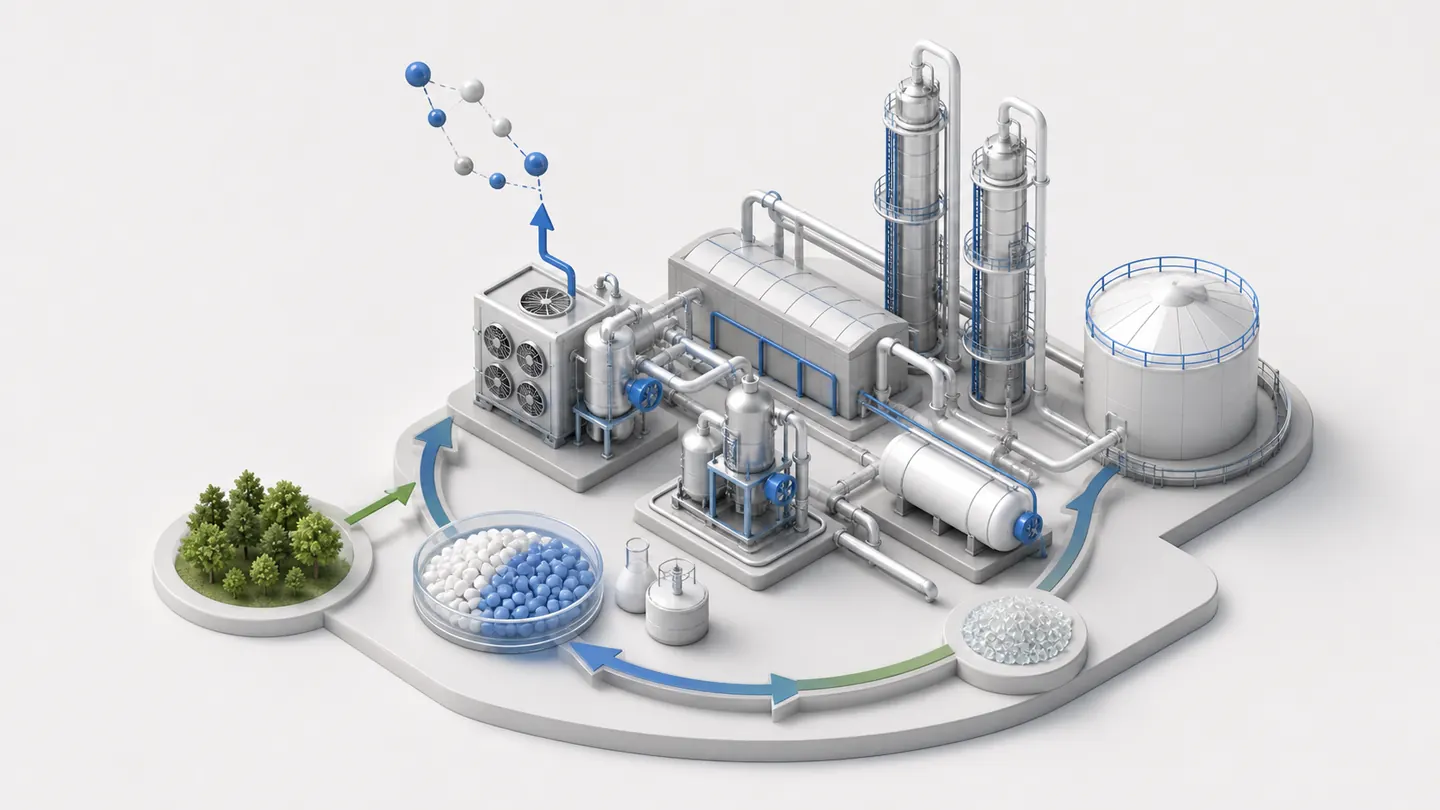
Japan's chemical decarbonization pathway is not a simple shift to hydrogen. It is a portfolio strategy shaped by three industrial problems: how to decarbonize high-temperature process heat, how to replace fossil carbon in chemical feedstocks, and how to capture or store the CO2 that remains.
That is why Japan's roadmap combines hydrogen, ammonia, CCUS, bio-based feedstocks, plastic-to-oil recycling and alcohol-to-chemicals routes. The story is less about one breakthrough technology and more about adapting existing petrochemical assets while lowering their carbon intensity.
Why chemicals are hard to decarbonize
NEDO's Green Innovation Fund project explains that most plastic raw materials are derived from naphtha, and that roughly half of CO2 emissions from Japan's chemical industry are associated with processes such as naphtha cracking for basic chemicals. This matters because chemicals use carbon in two ways: as process energy and as a molecular feedstock.
Switching electricity to renewable power is not enough. The industry must also address cracking-furnace heat, low-carbon hydrogen and ammonia supply, carbon capture infrastructure, and circular or bio-based carbon inputs.
1. Ammonia and hydrogen first target naphtha-cracker heat
One of the clearest industrial signals is fuel switching in naphtha cracking furnaces. In March 2024, Idemitsu announced that it had demonstrated ammonia combustion in a commercial naphtha cracking furnace at the Tokuyama Complex. During the February 6-8 trial, more than 20% of existing fuel was replaced with ammonia, and combustion was confirmed. IHI supplied the ammonia single-fuel burners for the demonstration.
The importance is not that full commercial conversion has already been achieved. The point is that decarbonization is being tested inside one of petrochemicals' central assets: the naphtha cracker. The next questions are safety, NOx control, ammonia supply, operating stability and cost.
NEDO's related project aims to develop cracking furnaces and burners by 2030 that use ammonia and hydrogen as CO2-free heat sources while targeting energy consumption and manufacturing cost levels comparable to current naphtha cracking furnaces.
2. Hydrogen is a fuel and an upstream chemical platform
Japan enacted the Hydrogen Society Promotion Act in May 2024 to promote the supply and use of low-carbon hydrogen and its derivatives. The framework covers not only hydrogen, but also ammonia, e-fuels and e-methane. Price-gap support and hub development support are key mechanisms.
On the corporate side, Asahi Kasei has started operation of a multi-module alkaline water electrolysis pilot plant in Kawasaki, aimed at 100 MW-class systems. Asahi Kasei and JGC have also been involved in a green ammonia demonstration using hydrogen from the 10 MW-class system at the Fukushima Hydrogen Energy Research Field.
For chemicals, hydrogen should not be viewed only as an energy carrier. It is also upstream of ammonia, methanol, synthetic fuels, reduction chemistry and low-carbon feedstock routes.
3. CCUS is infrastructure for residual emissions
CCUS is also part of the roadmap. METI and ANRE describe the CCS Business Act, enacted in 2024, as a step toward creating a business environment for private CCS ventures in Japan. In April 2026, Japan's Cabinet approved orders related to the enforcement date of the Act on Carbon Dioxide Storage Businesses.
JOGMEC has selected advanced CCS projects and describes the Japanese government's target of 6 to 12 million tonnes per year of CO2 storage by 2030.
For chemical companies, CCUS is not a generic decarbonization label. Buyers and suppliers need to ask which emission source is captured, whether CO2 is stored or used, where transport and storage responsibility sits, and how much reduction is achieved on a lifecycle basis.
4. Low-carbon feedstocks are moving through plastic recycling, bio-based inputs and alcohol routes
Feedstock substitution is already moving closer to commercial practice. Mitsui Chemicals announced in 2024 that it had fed pyrolysis oil from plastic waste into a cracker at its Osaka Works and begun producing and selling chemicals and plastics through a mass balance approach. ENEOS and Mitsubishi Chemical announced in 2025 that they had completed a plastic-to-oil chemical recycling facility at Mitsubishi Chemical's Ibaraki Plant in Kamisu, Ibaraki Prefecture.
Another route is alcohol-to-chemicals. Sumitomo Chemical has been building a pilot facility under a NEDO Green Innovation Fund project to produce propylene directly from ethanol, aiming to broaden future options beyond fossil naphtha.
These routes will not replace conventional naphtha overnight. In the near term, the practical focus will be ISCC PLUS and similar certification, mass-balance controls, traceable feedstocks, low-carbon product grades and customer documentation.
Takeaway
Japan's chemical decarbonization is moving from demonstration toward selective commercialization. Ammonia-fired crackers, green hydrogen, water electrolysis, CCS legislation, plastic-to-oil recycling, bio-based feedstocks and ethanol-to-propylene are not separate headlines. They are parts of one industrial transition around petrochemical assets.
The core pattern is not one technology replacing another. It is a gradual recombination of existing petrochemical assets, low-carbon fuels, circular feedstocks and carbon-management infrastructure.
References
- NEDO: Development of Technology for Producing Raw Materials for Plastics Using CO2 and Other Sources
- METI: Green Innovation Fund
- Idemitsu: First in Japan to use ammonia combustion as fuel for a commercial naphtha cracking furnace
- IHI: Ammonia combustion technology for naphtha cracking furnaces
- METI/ANRE: Hydrogen Society Promotion Act
- Asahi Kasei: Multi-module hydrogen pilot plant in Kawasaki
- METI/ANRE: CCS Business Act
- JOGMEC: Advanced CCS Projects
- Mitsui Chemicals: Recycled chemical products from pyrolysis oil
- ENEOS and Mitsubishi Chemical: Plastic-to-oil chemical recycling facility
- Sumitomo Chemical: Propylene directly from ethanol